The Tools
Three tools built around the same framework — each for a different entry point. The Relationship Oracle app is the full solution. The No B.S. Relationship Recovery AI is the interim tool while it's in development. Moonlight Oracle is for your partner, not for you.
Relationship Oracle
The full system — automated tracking, shutdown risk prediction, pattern recognition across months, AI guidance without manual file management.
No B.S. Relationship Recovery AI
GPT-based interim tool. Situation-calibrated guidance, structured journaling, shutdown pattern analysis while the app is being built.
Moonlight Oracle
For your partner — not for you. Reflective AI using non-clinical language. Safe to share without triggering defensiveness or shutdown.
Relationship Oracle
The No B.S. Relationship Recovery AI is a working interim tool — but it has real limitations. No persistent memory between sessions. Manual file uploads every time. No automatic pattern tracking. You manage the data. The app eliminates all of that.
What it actually is
A behavioural tracking and guidance system built around the frameworks in the No Bullsh*t Relationship Recovery Guide. Not therapy. Not a journaling app. A structured tool that tracks what's happening, identifies patterns you can't see in real time, predicts shutdown risk, and tells you what to do — and when.
What it does that the GPT can't
- Tracks daily state, behaviour, and signals automatically — no file uploads required
- Identifies patterns across weeks and months without manual data management
- Predicts shutdown risk and flags thaw signals before they're obvious
- Keeps your full situation context loaded — no re-explaining every session
- Stores every conversation so nothing gets lost between sessions
- Generates monthly analysis reports you can't produce manually
Features
My Situation
Set the context once. The AI works from your specific history — not generic scenarios.
Journal
Daily structured logging of state, behaviours, and signals. Pattern data, not guesswork.
Shutdown Risk Prediction
Analyses patterns over time. Tells you when a shutdown is likely, what stage it's in, and when it's safe to engage.
Tactical Guidance
What to say, what not to say, when to leave it alone. Built for real situations, not textbook scenarios.
AI Coach
Direct, non-therapeutic answers grounded in the book's framework. No clichés. No vague reassurance.
Weekly Check-in
Mood and regulation tracking over time. See where you are and where you're heading.
Assessment Reports
Know what stage they're in. When to engage, when to back off. No more guessing.
Monthly Analysis
State trends, thaw signals, and progress tracking. Patterns you cannot see week to week.
Q: Why is the GPT only temporary?
The GPT works within ChatGPT's infrastructure, which means no persistent memory between sessions without a paid plan, manual file management for journaling, and no automatic pattern tracking. The app removes all of those constraints. Same framework — built properly.
Get Early Access
Currently in development. Join the list and you'll be notified when it's ready.
No B.S. Relationship Recovery AI GPT — Interim
The primary companion to the book while the app is in development. Built on the shutdown pattern framework, the NICT model, and the full guide text — so it understands the specific dynamics you're dealing with rather than applying generic advice to an unusual situation.
What makes it different
Most relationship advice assumes both people are operating normally. This doesn't. It's calibrated specifically for shutdown — avoidance, withdrawal, emotional unavailability — and gives guidance that accounts for what's actually happening, not what a normal relationship problem would look like.
What you can use it for
- Quick reference — ask about any concept in the guide without re-reading whole chapters
- Regulation support — when anxiety spikes at 2am and you're about to act on panic, run it through here first before you send the message or make the gesture
- Journalling — log what's happening consistently and the pattern data builds into something you simply can't construct in your head alone. The GPT uses this to give you calibrated guidance rather than generic answers.
- Situation-specific advice — describe what happened and get a response calibrated to the actual framework, not generic relationship advice
- Ongoing support — working through something this complex over months or years is exhausting. Having somewhere to process it without burdening the people around you makes it more survivable.
Before you start — give it the full history
Before you begin journalling, give the GPT the full history of your relationship. Not a highlight reel. Not a case for the prosecution. The entire story — from the beginning. What brought you together. What was good. What went wrong. What you did. What she did. The patterns on both sides. The things you're not proud of. The things she did that hurt you. All of it.
The journal feature
The journal is one of the most valuable parts of this process. Over weeks and months, patterns emerge that you simply cannot track in your head — small shifts in behaviour, gradual changes in state, subtle increases or decreases in contact. Logging consistently gives you real data instead of anxious guesswork.
Critical: every entry must start with the date and time
Without the date and time, entries become impossible to track and pattern analysis breaks down. Format it simply: "Entry: Tuesday 14 January, 11:30pm" — then write the entry. You don't need to log everything every time — log what changed or what stood out.
Her state
Describe what you actually observed — not just a label. The key distinction is regulated vs dysregulated:
Regulated — calm, stable, functional
- Friendly and responsive — engaging normally, making conversation
- Warm — showing affection, smiling, initiating contact
- Neutral / functional — civil, going through the day without tension, no warmth but no hostility
- Quiet but settled — not engaging much but no visible distress or avoidance
Dysregulated — reactive, unstable, or shut down
- Avoidant — actively leaving rooms, not engaging, minimal responses
- Irritable or short-tempered — snapping, reactive, easily triggered
- Aggressive or confrontational — arguments, hostility, verbal attacks
- Visibly distressed — upset, tearful, anxious
- Completely shut down — no communication, no eye contact, minimal functional interaction only
Most days will sit somewhere in the middle. Log what you actually saw — the tool can help you categorise it if needed.
Behavioural changes
Anything different from the day before, however small. Positive changes and negative ones both. Neutral days are worth logging too — the absence of change is also data.
Eye contact
Was there any? Was it brief, sustained, or avoidant? Did she hold it or look away? This is a more sensitive indicator than most people realise.
Physical touch
Was any touch initiated or accepted? Did she initiate, allow, or reject it? What kind — passing contact, a hug, sitting close? Did she pull away or stay?
Communication channels active
Which channels were open today:
- Face-to-face conversation (brief and functional, or something more)
- Electronic communication — texts, messages, voice notes
- Phone calls
- Note whether she initiated or was responding to you — this distinction matters
Care acceptance
Is she allowing you to do things for her — cooking, practical help, general day-to-day care? Accepting care is often one of the first signs of thaw even when verbal or physical connection is still absent.
Your own state
How regulated were you? Did anything spike your anxiety? Did you manage it or did it leak into how you behaved? Be honest about this too.
Notable events or interactions
Anything specific that happened, positive or negative. Keep it factual — what happened, not your interpretation of what it meant.
ChatGPT has no memory between sessions. Every time you open a new conversation, it starts fresh — no context, no history, nothing. Your journal files are how you carry continuity from one session to the next. Without uploading them, the system resets.
First session? Start here
On your very first session, you don't need to upload anything. Open the GPT, give it your full relationship history (see the other tab), and start working. At the end of the session, type: "Generate my Master Journal file." Download it and save it somewhere safe. That file is your starting point for every future session.
Every subsequent session — the process
- Upload 2 files: your Master Journal (created at end of your first session) and your Latest Export (generated at the end of your most recent session).
- Send this exact message: "Use these files to rebuild my master journal. Keep all existing information, update it with anything new, and generate a clean updated master journal file."
- Work through your session — guidance, questions, journal entries, pattern analysis. Use it for as long as you need.
- Before you close: ask it to "Generate an updated export file." Download it when it does.
- Replace your previous Latest Export with the new file. Save over the old version. Your Master Journal stays unchanged — only the Latest Export gets replaced each session.
Rules — do not skip these
- Always upload both files at the start of every session
- Always replace your Latest Export with the new version at the end
- Do not try to manually edit or combine files yourself
- Do not rely on the GPT to "remember" anything between sessions — it cannot
Think of it as: load your save file → update it → save it again. Skip any step and the system resets next session.
What's the Master Journal vs the Latest Export?
The Master Journal is your full running log — everything you've recorded since you started. The Latest Export is the file the GPT generates at the end of each session — a processed, structured version that includes its analysis of patterns and state. You need both because one is raw data and the other is contextualised understanding.
Free vs ChatGPT Plus
Free users
- Upload both files at the start of every session
- No way around this with a free account
- Takes about 60 seconds once you have the process down
ChatGPT Plus — recommended
- Use Projects to keep files persistent between sessions
- Files stay loaded — no uploading each time
- Still generate and save a new export at the end of each session
How to use Projects (ChatGPT Plus only)
In ChatGPT, go to the left sidebar and create a new Project. Give it a name — something like "No B.S. Recovery AI". Inside the project, open the No B.S. Relationship Recovery AI GPT. Upload your Master Journal and Latest Export to the project's file storage — these files will persist across all conversations within that project.
When you start a new session inside the project, the files are already there. Still send the rebuild message at the start, and still generate an updated export at the end — but instead of downloading and re-uploading, update the stored file directly in the project.
Q: Do I need the book to use this?
The book gives you the framework that makes the tool make sense. You can use the tool without it, but the book is where the shutdown pattern and why standard approaches fail is explained in full. The tool works better with that context.
Q: What do I need to get started?
A free ChatGPT account. New users will be prompted to create one when they open the link. The tool itself is free. ChatGPT Plus makes journal management easier but isn't required.
Opens in ChatGPT. Free to use.
Moonlight Oracle
This tool is not for you — it's for them
Moonlight Oracle is for the partner who has shut down or withdrawn — not for the person reading this site. Do not share the Relationship Oracle, this site, or the book with your partner. Any of those would register as evaluation, pressure, or diagnosis — and would make things worse. Moonlight Oracle is different. It is safe to share.
Why it works when nothing else does
Someone in shutdown cannot engage with clinical language, structured frameworks, or anything that feels like being analysed. The moment they sense evaluation — even well-intentioned evaluation — they close further.
Moonlight Oracle uses reflective, spiritually-framed language rather than clinical or therapeutic terminology. There is no diagnosis. No framework. No evaluation. It simply creates space for someone to slow down, surface what they're actually feeling, and think without pressure or agenda. It asks simple questions and follows where they go.
This gives your partner a way to access their own emotional state without feeling watched, assessed, or managed. That access is exactly what shutdown prevents — and exactly what clinical or relationship-focused tools trigger the defence against.
What it is and isn't
- A calm reflective space — not analysis, not advice, not relationship guidance
- Uses spiritual framing rather than psychological or clinical language
- No references to this site, the book, or the shutdown framework
- No sign-up required — just open it and use it
- Completely standalone — nothing connects back to you or this system
Q: How do I share this without it looking like I'm managing them?
Don't frame it as something that will help the relationship. Share it as something that might be useful for them personally — a space to think when things feel tangled or unclear. The link is completely standalone. Nothing on the page connects back to you, this site, or the book.
No sign-up required. No references to this site or the book.
If nothing you've tried has worked, this explains why
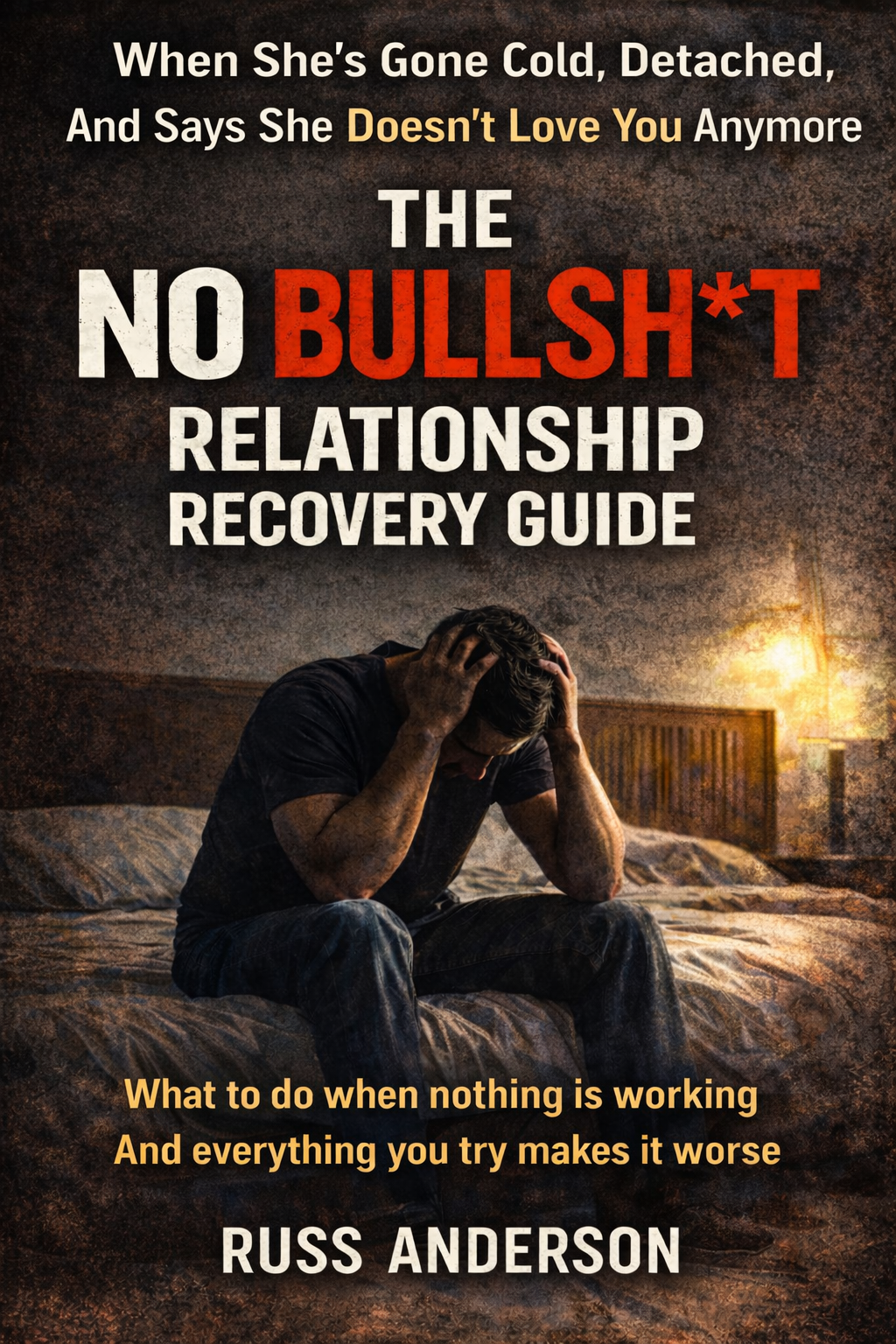
The No Bullsh*t Relationship Recovery Guide — When She's Gone Cold, Detached, and Says She Doesn't Love You Anymore
The book is the foundation everything else is built on. The shutdown pattern, why standard approaches backfire, and what actually changes things — explained in full.
By Russ Anderson