Why Couples Therapy Often Makes Emotional Shutdown Worse
22 January 2026
Couples therapy is the default advice. If your marriage is struggling, you go to therapy. But if your wife is already emotionally shutdown — checked out, cold, saying she doesn’t know if she loves you anymore — therapy may be making things significantly worse, and most therapists won’t tell you that.
This isn’t a criticism of therapy in general. It’s a specific problem that arises when standard couples therapy approaches meet a specific relational dynamic. Understanding why it backfires is important, because the well-meaning suggestion to “just go to therapy” can cost you months of progress.
The pursuer-withdrawer problem
John Gottman’s decades of couples research identified several patterns that predict relationship breakdown. One of the most consistent is the pursuer-withdrawer dynamic: one partner seeks more emotional engagement, the other retreats from it.
In shutdown situations, this pattern is almost always present — and usually long-established. The pursuit-withdrawal cycle is the engine that’s been running in the background for years, often long before the word “shutdown” would have meant anything to you.
Standard couples therapy typically involves:
- Both partners articulating their needs and feelings
- Active listening exercises
- Vulnerability sharing
- Direct communication about what’s not working
Every one of these interventions requires the withdrawing partner to do exactly what their nervous system is currently refusing to do: become emotionally visible, express inner states on demand, and tolerate being observed while doing so.
Evaluative visibility is the experience of being watched, assessed, and required to perform to a standard. For an avoidant partner — already running a defensive withdrawal strategy — the therapy room is evaluative visibility at maximum intensity. Two people plus a professional are now all focused on what the withdrawing partner is or isn’t feeling.
The result, reliably, is that the withdrawing partner withdraws further.
Why EFT specifically can accelerate the problem
Emotionally Focused Therapy (EFT), developed by Sue Johnson, is the most evidence-based couples therapy model available. For most couples with typical attachment dynamics, it produces good outcomes. But the clinical literature contains an important caveat that rarely makes it into general advice.
EFT works by accessing and restructuring attachment emotions. The model asks partners to identify what they’re feeling beneath their defensive behaviour, and to make themselves emotionally vulnerable to their partner in the therapy room. For an anxiously attached person, this is therapeutic. For a dismissive-avoidant person who has spent their entire life managing closeness by suppressing attachment signals, it’s threatening at a fundamental level.
The problem isn’t the therapist’s competence. It’s that the model’s core mechanism — emotional activation and vulnerability — conflicts directly with the coping mechanism currently running in your partner.
The therapy room as pressure environment
Consider what the therapy room looks like from the perspective of a partner who’s emotionally shut down:
- An expert is present. Their assessment carries authority.
- Both of you are there to fix a problem. The problem is largely attributed to what she’s feeling, or not feeling.
- She’s expected to access and express inner states that she may genuinely not be able to reach.
- Whatever she says will be analysed, responded to, and used as data.
- Saying nothing, or saying she doesn’t know, makes her look broken or unwilling.
This is not a safe environment for someone whose nervous system is already in a defensive withdrawal state. The conditions that produce emotional openness — safety, low stakes, no observation, no expectation — are the opposite of what a therapy room provides.
What often happens in practice: one or two sessions of apparent progress, followed by a more pronounced withdrawal than before the therapy started. The brief opening in the session triggered a threat response that took days to settle.
- She becomes noticeably colder in the days following sessions
- She starts refusing to attend or finding reasons to cancel
- Session conversations shift to her defending herself rather than exploring
- You feel more pressure to perform emotional understanding than before
- Nothing from sessions carries over into daily interaction
What to look for if you do seek help
Not all therapists approach shutdown the same way. The difference between a therapist who accelerates the problem and one who doesn’t usually comes down to whether they’re attachment-informed and trauma-aware.
Specifically:
Attachment-aware means they understand that avoidant defence strategies exist for a reason, that pushing through those defences directly is counterproductive, and that safety has to be established before vulnerability can be requested.
Trauma-informed matters because dismissive-avoidant and disorganised attachment patterns often have early developmental roots. A therapist who treats shutdown as a communication problem rather than a nervous system response will apply the wrong tools.
Individual therapy first is often more useful than couples therapy in the early stages of shutdown. If your partner can work with a good individual therapist on her own terms, without the pressure of your presence and the relationship’s stakes in the room, there’s more chance of genuine movement.
The pursuer-withdrawer research also suggests that the pursuing partner doing their own work — reducing the pressure they’re applying to the situation, regardless of whether the withdrawing partner does anything — often does more to create the conditions for change than couples sessions where both attend under pressure.
No. The timing and format matter. Therapy with the right therapist, after the acute shutdown phase has passed or moderated, with both partners able to access some emotional availability, can be genuinely useful. The problem is specifically couples therapy pushed too early into an active shutdown, or with a therapist whose approach increases pressure rather than reducing it. The goal is the right intervention at the right moment, not no intervention at all.
The underlying problem with most advice
The core issue — with therapy and most other standard advice — is that it’s designed for couples with a normal range of emotional availability. The advice assumes both partners can access and express their feelings when prompted. If that were true, you probably wouldn’t be here.
Shutdown is a specific state. It has a specific structure, specific triggers, and specific conditions under which it begins to lift. Applying general relationship advice to it is like treating a seizure with general first aid — not wrong in intent, but not matched to what’s actually happening.
The book covers the full structure of shutdown: what it actually is, what drives it, and what the correct interventions look like at each stage — specifically for situations where standard approaches have already been tried and made things worse.
If nothing you've tried has worked, this explains why
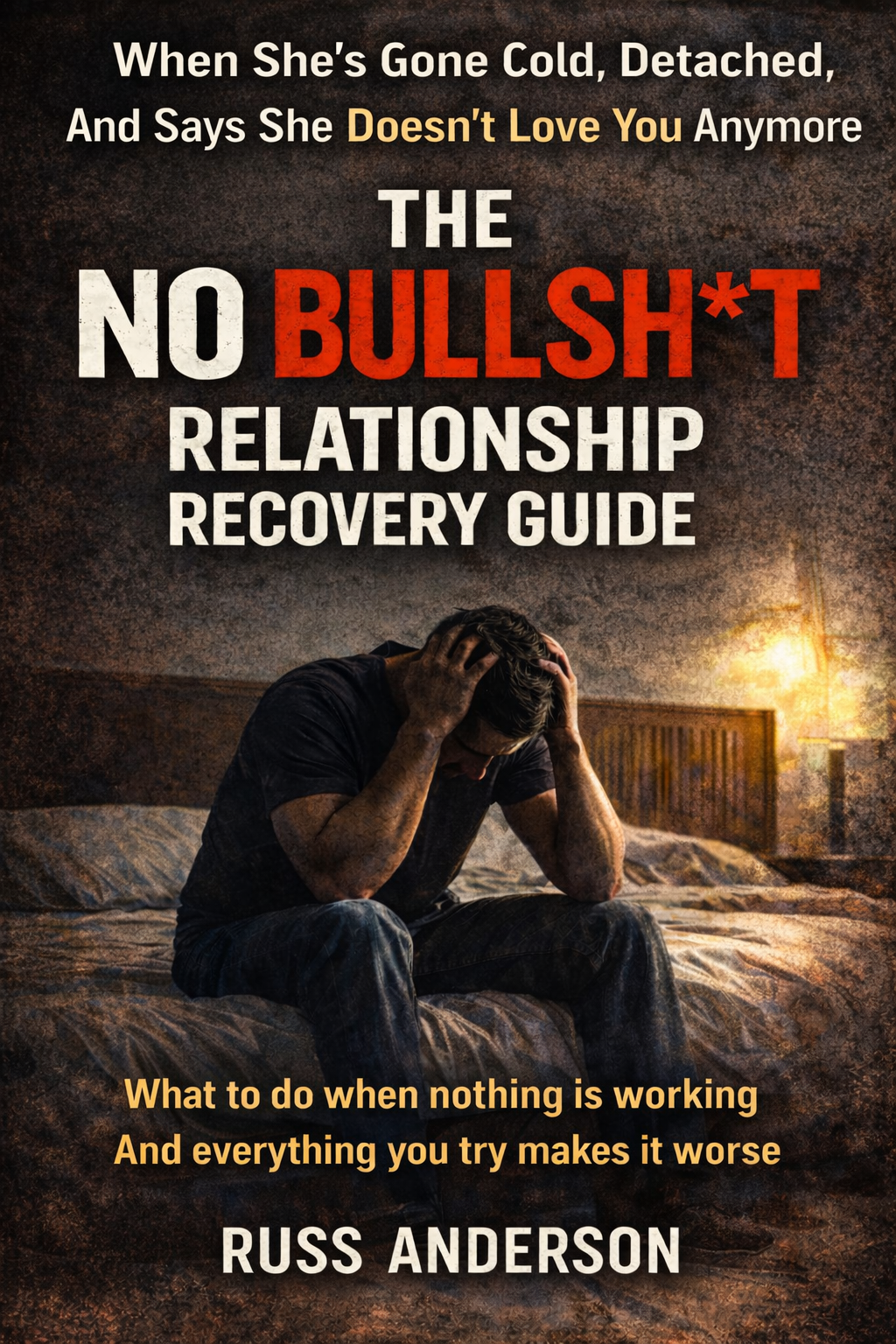
The No Bullsh*t Relationship Recovery Guide — When She's Gone Cold, Detached, and Says She Doesn't Love You Anymore
The shutdown pattern, why standard approaches backfire, and what actually changes things — explained in full. Written from inside the situation, not from theory.
By Russ Anderson
Free AI Companion Tool
Get guidance specific to your situation — not generic advice written for the average relationship problem.
No B.S. Relationship Recovery AI →