Avoidant Attachment in Relationships: How It Destroys Marriages and Leads to Shutdown
15 January 2026
If your wife has become emotionally unreachable, cold where she used to be warm, and you have no idea what changed — there’s a good chance you’re not dealing with a relationship problem in the ordinary sense. You may be dealing with an attachment system that’s gone into full defensive mode.
This isn’t a character flaw, and it isn’t simple disconnection. It’s a pattern rooted in how her nervous system learned to manage closeness — and once you understand the mechanics, a lot of what’s been happening will start making sense.
Attachment theory, developed by John Bowlby and later tested empirically by Mary Ainsworth, describes how early experiences with caregivers shape the strategies we use to manage intimacy throughout life. In adults, these strategies are relatively stable — but they become most visible under relationship stress.
The three patterns you need to understand
Researchers Mary Main and Judith Solomon identified a third attachment pattern beyond Ainsworth’s original secure/anxious/avoidant — what they called disorganised attachment. In adult relationships, this maps onto what’s now called fearful-avoidant or “disorganised-avoidant.” The distinction matters because the three avoidant types behave very differently in long-term relationships.
Dismissive-avoidant
Bartholomew and Horowitz’s 1991 classification described the dismissive-avoidant person as holding a positive view of themselves and a negative view of others. In practice this means: I’m fine on my own. I don’t need much. Close relationships aren’t that important.
What it looks like in a marriage:
- Practical, reliable, present in the functional sense
- Uncomfortable with emotional conversations that go too long
- Responds to emotional needs with problem-solving rather than emotional engagement
- Becomes colder and more withdrawn when the relationship demands more from them
- Can appear as self-sufficient to the point of indifference
The dismissive-avoidant person isn’t cold by nature. In early relationships, or in moments of genuine safety, they can be warm and engaged. But the attachment system is running a background process: proximity is risky. If I get too close and it fails, I won’t be able to handle it. The defence is preemptive distance.
Over years, in a long-term marriage under pressure, this defence escalates. The more the anxious partner pursues — more conversations, more requests for reassurance, more emotional pressure — the further the avoidant partner retreats. This is the pursuer-withdrawer dynamic, and it’s one of the most documented patterns in couples research (Gottman, 1994; Christensen & Heavy, 1990).
Eventually the retreat becomes total. Emotional shutdown.
Fearful-avoidant (disorganised)
Mikulincer and Shaver’s research describes fearful-avoidant adults as holding a negative view of both themselves and others. They want closeness — deeply — but closeness itself feels dangerous. The result is an approach-avoidance conflict that plays out as the hot-and-cold pattern many people experience.
What it looks like in a marriage:
- Intense connection followed by sudden withdrawal
- Accusations that you’re suffocating them when you’ve done nothing different
- Periods of warmth and apparent normality that end without explanation
- Genuine confusion about what they want — not manipulation, actual internal conflict
- History of difficult or unpredictable relationships before you
The fearful-avoidant person craves intimacy and fears it in equal measure. When closeness increases, the threat alarm goes off and they pull back. When they pull back and feel the distance, the attachment system activates again and draws them forward. This is not a conscious cycle. It’s a nervous system oscillation.
- Warmth followed by coldness — read as mixed signals, actually nervous system regulation
- Anger at perceived crowding — read as rejection, actually activated threat response
- ”I don’t know what I want” — read as passive aggression, actually genuine internal conflict
- Brief moments of deep connection — read as the real her, actually the window between approach and avoidance
The anxious-avoidant pairing
Research consistently shows that anxious and avoidant partners are disproportionately drawn to each other. Hazan and Shaver’s 1987 adult attachment studies and subsequent replication work all point to the same dynamic: the anxious partner’s pursuit activates the avoidant partner’s withdrawal, which activates the anxious partner’s pursuit. A self-reinforcing cycle with no natural off switch.
This isn’t a coincidence or bad luck. The familiarity of the dynamic is part of the attraction. The anxious partner experiences the avoidant partner’s emotional unavailability as familiar. The avoidant partner experiences the anxious partner’s need as a manageable source of connection that doesn’t require full exposure.
It works — until it doesn’t.
Why the standard advice backfires
Most relationship advice is written for secure attachment. It assumes both people have the same basic capacity for the strategies being recommended. The advice typically looks like:
- Communicate more openly
- Schedule time together
- Express your needs clearly
- Go to couples therapy
For an avoidant partner — particularly a dismissive-avoidant in withdrawal mode — each of these increases what I’d call evaluative visibility: the sense of being observed, assessed, and required to perform emotional availability on demand.
More open communication means more emotional exposure.
Scheduled time together means obligated proximity.
Expressing needs clearly means the partner now knows exactly how much they’re failing.
Couples therapy means all of the above, in front of a witness, with professional authority behind the expectations.
The harder you push for emotional engagement, the deeper the system retreats. This is not stubbornness or manipulation. It is a nervous system doing exactly what it was trained to do.
How avoidant attachment escalates to shutdown
Shutdown isn’t a decision. It’s the end state of an avoidant defence system that’s been running at maximum capacity for too long.
The progression, as it typically unfolds:
- Gradual withdrawal — less spontaneous affection, shorter emotional conversations, increasing use of practicality as a substitute for intimacy
- Selective engagement — warmth in low-pressure contexts (doing things side by side, practical cooperation), absence in high-pressure ones (direct emotional conversation, physical closeness)
- Protective detachment — the appearance of having switched feelings off. “I don’t know if I love you anymore.” “I don’t feel anything.” This is not the truth about her feelings — it’s the deactivation of the attachment system as a protective mechanism
- Functional presence without emotional engagement — she’s still there, still doing the practical things, but emotionally has stepped behind glass
This last stage is what makes shutdown so disorienting. A person who no longer loves you leaves. A person in shutdown stays — because some part of the attachment system is still engaged — but operates from behind a wall that feels impenetrable.
”I don’t love you” during active shutdown is not the same sentence as “I don’t love you” after genuine disengagement. In shutdown, the attachment system has deactivated feeling as a protective strategy. The absence of felt love is a symptom of the defence, not a report on the underlying state. This is Bowlby’s deactivating strategy — suppressing attachment signals to avoid the pain of anticipated rejection or loss.
What actually changes things
Not more pressure. Not more emotional conversations. Not ultimatums.
What the research supports — and what I found to be true in practice — is reducing the evaluative pressure, creating genuine safety without demanding it be acknowledged, and understanding that the oscillation is not personal.
The shutdown pattern has a structure. Understanding that structure is the first step out of the loop that’s been making things worse.
The full framework — what’s actually happening at each stage, and what moves through it without triggering deeper withdrawal — is in the book.
If nothing you've tried has worked, this explains why
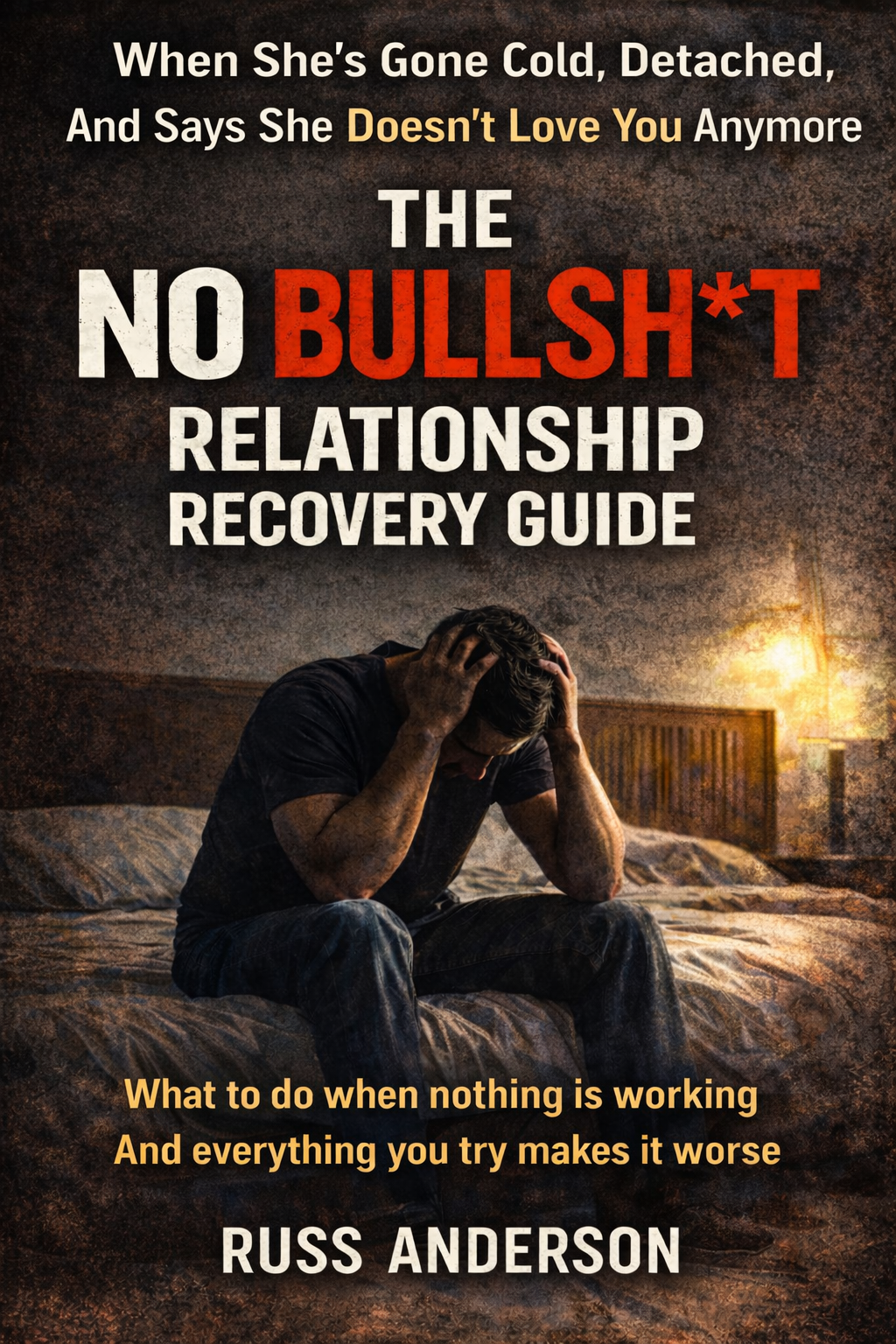
The No Bullsh*t Relationship Recovery Guide — When She's Gone Cold, Detached, and Says She Doesn't Love You Anymore
The shutdown pattern, why standard approaches backfire, and what actually changes things — explained in full. Written from inside the situation, not from theory.
By Russ Anderson
Free AI Companion Tool
Get guidance specific to your situation — not generic advice written for the average relationship problem.
No B.S. Relationship Recovery AI →