Antidepressants and Emotional Distance: What the Research Shows
12 February 2026
If your partner is on antidepressants and has become emotionally unavailable — not just sad or flat, but genuinely unable to access or express emotion — there’s a documented medical explanation that rarely gets mentioned in relationship advice, and almost never comes up in couples therapy.
This post is not medical advice and isn’t suggesting anyone changes their medication. It’s practical information about a real phenomenon that affects relationships in specific, identifiable ways — because understanding what’s happening is the first step to navigating it without making things worse.
SSRI-induced emotional blunting: what the research says
The phrase “emotional blunting” describes a cluster of effects reported by people taking SSRIs (selective serotonin reuptake inhibitors — the most commonly prescribed antidepressants). It’s not a side effect that gets mentioned prominently in prescribing information, but it is documented in clinical literature.
What this looks like in a relationship:
- Reduced emotional reactivity — less warmth, less anger, less obvious response to things that would normally register
- Difficulty expressing affection or receiving it — not unwillingness, actual reduced capacity
- “I don’t feel anything” as a literal description, not a defensive evasion
- Reduced sexual interest (a well-documented SSRI side effect with direct relationship impact)
- Flattened response to things that should matter — good news, bad news, significant moments
The critical point is that emotional blunting produced by medication is not the same as emotional shutdown produced by avoidant attachment defence. They can look similar. They can co-occur. But the mechanisms are different, and conflating them leads to the wrong interventions.
Why this is rarely addressed in relationship therapy
Standard couples therapy takes the partners’ emotional states as presented. If one partner reports not feeling love, or feeling nothing, the therapy works with that presentation. The question of whether the felt emotional state is being pharmacologically altered doesn’t typically arise.
This is a significant gap. SSRI emotional blunting can produce a clinical presentation — emotional unavailability, reduced connection, “I don’t know what I feel” — that is indistinguishable from attachment-based shutdown in a therapy room. A therapist not specifically trained in psychopharmacology and its relationship effects will likely work the emotional content as if it’s purely relational.
Emotional blunting differs from depression in a key way: depression suppresses positive emotion while leaving negative emotion largely intact (or even amplified). Blunting suppresses both — a pharmacological flattening of the emotional range. A partner who feels “nothing” may be accurately reporting a medication-induced state, not a collapsed attachment.
When opioid-based medications are also in the picture
The intersection of SSRIs with opioid-based medications (prescribed opioids, codeine-containing preparations) adds another layer that the relationship research doesn’t address at all.
Opioid receptors are directly involved in social bonding. The brain’s opioid system mediates the experience of connection, warmth, and attachment satisfaction. Research by Panksepp, Herman and colleagues documented the role of endogenous opioids in maintaining social bonds — the “social comfort” system operates substantially through the same receptors targeted by opioid medications.
Opioid medications suppress this system. The effect on emotional bonding is not incidental — it is a direct pharmacological consequence. Combined with the emotional range restriction produced by SSRIs, the picture is a person who has reduced access to attachment feeling on two different neurochemical dimensions simultaneously.
What this means practically:
- She may not be able to feel the connection even in moments where it would otherwise be available
- “I don’t love you” may be an accurate description of her currently experienced state — not because the underlying attachment has dissolved, but because the neurochemical substrate for feeling it is suppressed
- Warmth in brief, unguarded moments may reflect windows when the suppression is lighter — correlated with timing of doses, sleep, stress load
- Correlation between emotional availability and medication timing (different times of day, dose changes)
- Changes in availability following medication adjustments
- Emotional availability that appears more in the morning before doses, or at other consistent windows
- Her own description of feeling “nothing” or “flat” even about things she used to care about
- Relationship between emotional unavailability and physical discomfort or pain management
How to hold this information
This explanation doesn’t make the situation easier in the moment. But it changes the interpretive frame significantly.
If your partner’s emotional unavailability is substantially medication-driven, it is not a verdict on the relationship. It is not a report on her feelings that should be taken at face value. It is not evidence that she has decided something.
It also means that the interventions designed for attachment-based shutdown — reducing evaluative pressure, creating safety, changing the dynamic — may produce limited results until the pharmacological component is addressed. This is a conversation that belongs with her prescribing doctor, not in a couples session.
You’re not attributing blame — you’re noting a documented medical phenomenon that may be relevant to what you’re both experiencing. The most useful framing is curiosity rather than diagnosis: “I’ve been reading about SSRI emotional blunting — did your doctor ever mention that as a possibility?” This opens a door without creating a defensive response. What happens next is her choice.
What this adds to the shutdown picture
In practice, the situations that escalate to full shutdown often involve multiple overlapping factors: an avoidant attachment pattern that creates the underlying structure, external stressors that push the system into defence, and medication effects that flatten the emotional range precisely when genuine engagement would be most needed.
Understanding these as separate contributing variables — rather than as one monolithic “she doesn’t love me” conclusion — is the difference between a clear-eyed assessment of a complicated situation and a catastrophising loop that makes everything worse.
The book addresses how these variables interact, what the observable states look like when they’re all in play, and what the correct sequence of responses is at each stage.
If nothing you've tried has worked, this explains why
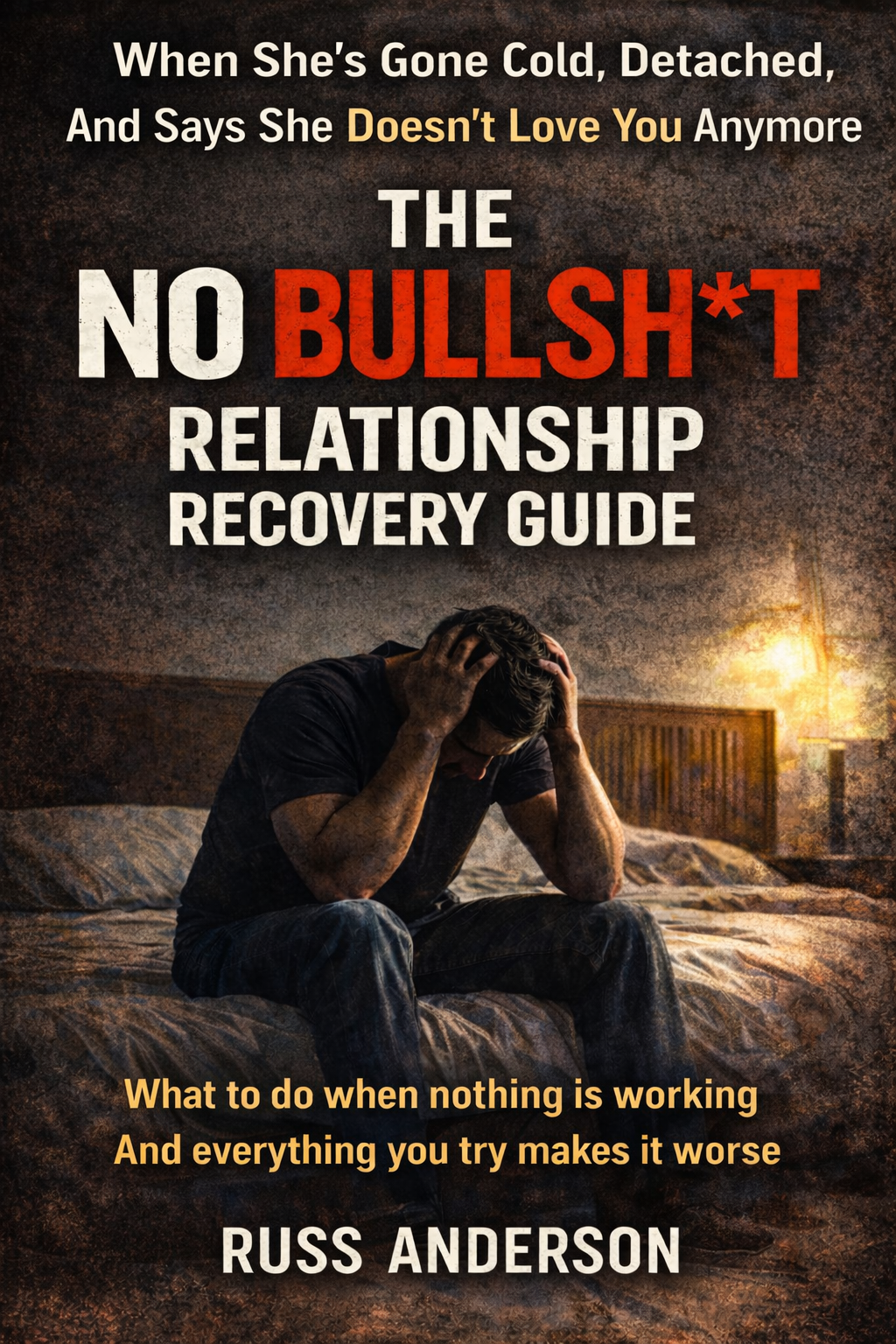
The No Bullsh*t Relationship Recovery Guide — When She's Gone Cold, Detached, and Says She Doesn't Love You Anymore
The shutdown pattern, why standard approaches backfire, and what actually changes things — explained in full. Written from inside the situation, not from theory.
By Russ Anderson
Free AI Companion Tool
Get guidance specific to your situation — not generic advice written for the average relationship problem.
No B.S. Relationship Recovery AI →